


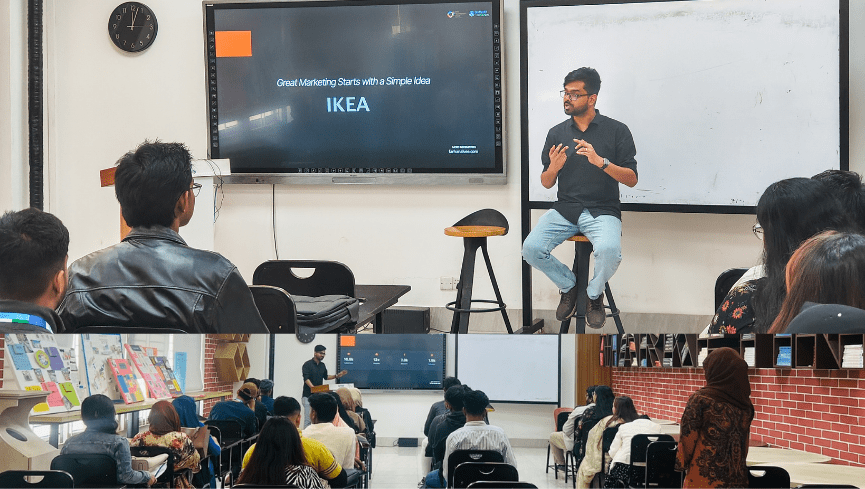
Recently, I had the opportunity to return to Daffodil International University (DIU)—this time not as a student, but as a speaker. I was invited by the DIU Marketing Club to conduct a session titled “Marketing Beyond Borders: Studying Abroad & Global Career Opportunities.”
The session was organized by DIU Marketing Club, in collaboration with Daffodil International University and the Faculty of Business Administration (FBE). It was an incredibly rewarding experience to engage with undergraduate marketing students who are at the very beginning of their professional journeys.
I began the session with a simple but powerful question: “Why did you choose marketing?”
For many students, the answers ranged from creativity and career prospects to curiosity and opportunity. This led us to a deeper discussion on what marketing truly is—not just advertising or social media posts, but a discipline rooted in understanding people, solving problems, and communicating value effectively. Marketing at its core, is about people. Tools change, platforms evolve, but human behavior remains central.
To make the discussion more practical and global, I shared examples from world-renowned Swedish brands like IKEA and Volvo.
IKEA started with a simple idea: making furniture affordable and accessible through flat-pack design. Its success lies not just in products, but in a clear understanding of customer problems and lifestyle branding.
Volvo, on the other hand, has built its global identity around one word—safety. For decades, the brand has communicated this message consistently across markets.
These examples helped students understand how strong branding and clear positioning can turn simple ideas into global success stories.
We then discussed how digital marketing has transformed the marketing landscape. Unlike the past, where marketing was limited to TV, print, and billboards, today’s marketers have access to data, personalization, and global reach—often from just a smartphone.
Students already participate in digital marketing ecosystems daily through platforms like Instagram, TikTok, and YouTube. Understanding how algorithms, content, and attention work is now a core marketing skill, not an optional one.
One of the most important parts of the session focused on future-ready skills for marketing students, including:
Communication and presentation skills
Storytelling and branding mindset
Digital and analytical thinking
Adaptability and continuous learning
I emphasized that while tools will keep changing, strong fundamentals and communication skills will always remain relevant, especially for students planning to study or work abroad.
A key takeaway from the session was how students can strategically use DIU Marketing Club as a real-life learning platform. Club activities—such as organizing events, creating content, managing teams, and handling sponsors—can act as a mini marketing agency experience if approached intentionally.
Rather than seeing club work as an extracurricular activity, students were encouraged to view it as professional training that can later be translated into CVs, portfolios, and interviews.
The session concluded with a simple message:
Marketing has no borders—if you prepare yourself properly.
I’m grateful to DIU Marketing Club, Daffodil International University, and the Faculty of Business Administration (FBE) for organizing such a meaningful session and for the warm hospitality. Most importantly, I’m thankful to the students for their engagement, questions, and enthusiasm.